I’ve been a bit fascinated by an episode of the Cortex podcast about Yearly Themes.
In the episode, Myke and Grey discuss what the over-arching theme of the year is. If I were to make-up a theme for 2018, it would be reinvention.
I’m in an inflection point of my life. One where I’m ready to let go of my past and look forward to things to come.
Recap
January-February
I was working at Inform in our new office - a co-working space that felt more like a downgrade. I wanted to line up another job so I could quit.
As a co-worker said to me later, “What are you still doing here?”. Touché.
Traveled to Las Vegas to visit friends and get my TSA pre-check.
Around mid-February, I interviewed and accepted my new place of work. Clear Labs. Hired on as a web developer.
March-May
I started my new gig. Forgot how much work it is being at a start-up, but quickly landed on my feet as we build the software from the ground up.
Traveled to Portland for a quick visit to see friends.
Ended April with a vacation to Norway and Sweden with my friend, Teagan. We saw the fjords, viking ships, and some questionable art.
The Questionable Art Pose
Visited the Color Factory & Ice Cream Museum. Watched my sister graduate college. Found out my co-workers at Inform got laid off.
June-July
Participated in my first Kubb competition. Was dating someone I thought could be good for me…
Got Life Insurance. Really didn’t think I’d need this, but after the financial incentives, I had to get it.
Reeling back from slow heart-ache.
September
The busiest month this year. Married my friends. Watched different friends get married in Colorado Springs. Started dating someone substantial. Went to St. Louis for the 2nd time for the Strangeloop Conference.
October-November
Participated in my very first triathalon. It was a relay, and I did the biking portion. We got third!
A Japanese experimental comedy-horror film that revolves around a group of seven schoolgirls who travel to one of their aunts' country homes, where they encounter supernatural events.
This is my last letter for the series, “Seven Degrees of Strangers”. If you haven’t followed the journey, you can check it out on my website. I’ve written about 6 different people I talked to one degree of separation apart.
For those of you who may have noticed an error, the phrase is six degrees of separation, not seven. I would like to say I did that on purpose. I didn’t. I could have lied and said this is to close the loop. To be frank, I was deluded by my title, I thought this would be a great experiment.
Nevertheless, Raina chose a wonderful person last. Someone with a perspective I don’t have, yet we had a fantastic conversation.
Enter Megan Jolly
Megan lives in Portland and met Raina through a basketball camp Raina’s husband was starting. I believe Raina chose to ask me to speak with Megan because of Megan’s vision impairment. She has Leber’s disease, a mitochondrial defect that affects the optic nerve and can lead to blindness. Men are more prone to blindness from this recessive trait, and Megan is one of the unlucky ones in the gene pool. She found out in 2016 when she was getting a new prescription for her glasses. That was subsequently the last time she drove.
Going Blind
Megan isn’t completely blind. She’s got no central vision and about 45% of her peripheral vision. Before her diagnosis, Megan’s life was playing soccer, working in non-profit land, hanging out with friends. And after the diagnosis, Megan still does many of the same things, but some activities are a lot harder. Since Megan doesn’t drive, she relies on public transportation. While service is good in Portland, it takes longer to travel. Also, Megan can’t do some of her finances, so her friend became her power of attorney since the banking website she’s supposed to use has poor accessibility support.
For the first two months, Megan’s life wasn’t going well. A few months in, Megan’s mom found the Oregon Commission for the Blind and got her to sign up.
Oregon Commission for the Blind
The Oregon Commission for the Blind is a state agency with paid staff to help teach the blind best practices by delivering courses. They also help students find jobs. The classes run 4 terms a year and each of them lasts around 12 weeks. These classes range from orientation and movement to sightless self-defense.
The instruction is 1 to 1, tailored for each student. Everyone’s skill level is different, like computer competency. Megan’s an expert at using a computer, so the teacher tailored her education accordingly. Someone with no computer skills would have to start out as a novice, like starting by using a keyboard.
While the curriculum has some general guidelines and best practices, the teachers help with one-off things too. Megan wanted to vote for the upcoming election but didn’t know how to do it. Her instructor and she went to the voting station and the person manning the booths didn’t know either. They investigated and figured it out given some other voting staff support.
The commission’s job is to help the blind reach the point of doing what people normally do. Megan loves to hike, so with her instructor James, she’s been able to hike around. Some spots are a bit tricky than others. She recommends Angel’s Rest if you’re every around Portland want to see an awesome view of the Columbia River.
As I was doing some follow-up research about the organization, I ran across this quote. “The real problem of blindness is not the blindness itself—not the acquisition of skills or techniques or competence. The real problem is the lack of understanding and the misconceptions which exist.” It’s from the National Federation for the Blind. After talking to Megan, I walked away with a better understanding of blindness and how it affects us.
Takeaways
I loved talking to Megan. I was able to learn how her disability does not limit her. She told me how the commission has sightless defense classes, how students there come to learn about blind athlete events such as dragon boat races. She is mentally competent, and would like some kind takeaways for readers.
If you come across a blind person, please ask if they need help before helping them.
Don’t touch them. Introduce yourself and ask them if they assistance.
For my web developer friends out there, please build websites with accessiblility in mind
I’ve opened my eyes to a new kind of awareness by talking to Megan. So if you have the chance, strike up a conversation with a visually impaired person. You never know what you’ll learn.
Acknowledgments
I want to take this opportunity to thank everyone who helped me with this project. This wouldn’t be possible without all of you readers who have stuck with me, even while I went through a few months hiatus. It’s time for me to re-read Steven Pressfield’s “The War of Art”. First, I’d like to recognize Megan Gebhart whose blog turned book, 52 Cups of Coffee, inspired me to write this short series.
Of course, I’d like to call out every person I got to interview. To my good friend, Simon, who helped kick off this series and being kick-ass at what he does and reminds me how much potential we have. To the fantastic Evan whose illustrations elevate the writing and logo that signifies the connections between all of us. To Joe for being such a great storyteller and having such a great philosophy on life. To Mary who gave me a phone call earlier this year and continues to remind me how much connections matter. To Julie for writing a book that read after and uses her last concept as a mantra for life. To Raina for waiting patiently for my piece to come out and for reaching out and being a champion. To Megan for showing me a part of life I rarely get to see. You all have been great guests, and I thank every one of you.
And I thank my family and friends for sticking with this series. Your feedback has inspired me to continue writing. And maybe had to stick around and were forced to listen to me talk about all of my guests. Thank you. You’re the best.
If you’ve been keeping up with me for this long, that means I have some loyal readers out there. Hi, it’s been a while. Haven’t spoken about this project in forever. I’ve had this aching feeling of completing this project for months. Every time I would start, I’d get distracted by something else. A new job, obligations, travel. Needless to say, I had trouble with time management for creative pursuits.
And now I’m back. Ready to tell you about the last two people I interviewed for “Seven Degress of Strangers”. This week, I’ll recall a conversation I had with Raina Evans, last September. Yikes. Raina, if you’re reading this, I’m truly sorry this took so long.
Enter Raina Evans
After speaking with Julie, I asked for someone diverse, with a varied background. Enter Raina Evans.
Raina and Julie’s ex-husband used to work for a youth organization in the mid to late 90s. Her daughter and Julie’s oldest son used to play together and were the same age.
On the day I spoke to Raina, she had finished a nice brunch with her daughter and grandchild at Black Bear Cafe. Raina was radiant. This woman was full of energy, excited to talk about what she does and what she’s accomplished.
Raina’s worn many hats. She is the current owner of Ready to Rent, a program to train residential renters. As the owner of the program, Raina trains the instructors of this program. After speaking to Raina, I only found a glimpse of how rich her life really is.
She adds so much detail through her language and exuberance of how she talks. It showed in our conversation in the tiniest details, like her mention of how her brunch went. I knew this was going to be an interesting conversation.
Ready to Rent
In the early 2000’s, Raina was working at the Portland Housing Center. This organization she worked for ran a training program for first time renters. They called the program “Ready to Rent”. In 2006, the board wanted someone to run this program. They asked around, but couldn’t find someone with the right skill set. They kept getting candidates with social work backgrounds. What they were looking for than management and marketing backgrounds. Putting two and two together, and they looked at Raina’s background and saw a great fit. But the first time the board asked her, Raina refused. They came back a few days later and asked again. And again, she refused. On the third try, Raina relented. She just got married a few months prior and lost her position on the board. The new marriage came with their own children. Raina thought this was the third time, and perhaps this might be her calling.
Raina gave the board one year to try it out. And then it turned to giving it a second year. By the third year, Raina stayed at this position. But the board came back and told Raina they would be cutting the program. The board chair asked Raina if she might want to run “Ready to Rent” as a private entity. Ready to Rent’s curriculum is one of a kind. There isn’t one quite like this. Raina, with the support of the chair, spun this out on her own. To her surprise, the program grew. A lot. Raina took this operation across the US and Canada. She trains instructors to be certified in the program.
By 2010, Raina took the IP from the commission. She’s been working at this for a decade and still going strong.
Memorable Moments
I asked Raina what were some memorable moments she’s had training adults. She gave me two stories.
1
On the big island of Hawaii, the mayor of Hawaii country was amongst the group Raina trained. Raina doesn’t jump into the material on the first day of training. She focuses instead on how adults learn. After that first day, Raina jumps into the program.
The mayor spoke with Raina after the class was over and said, “Now I get it. We’ve been communicating wrong this whole time. We’ve been communication with our people and with clients the wrong way. You taught us how adult learners learn.” The course changed the policy on communicating with others. This was an eye opening experience for the mayor.
2
Raina came out to teach in Sacramento, California. During the first week, she taught city and county workers. The second week, she taught a consortium of agencies. Today, about 100 trainers in Sacramento delivers this curriculum. But it didn’t stop there. The woman who first asked Raina to teach in Sacramento moved to another county. She asked Raina to teach people in the county over as well.
Raina continues to thrive by a viral effect. The cirriculum is effective from years of iteration. People take away a lot from the course. All in all, Ready to Rent continues to grow through word of mouth. As Raina puts it, “the program markets itself.”
3
Raina’s niece and boyfriend had a baby shower. The family’s mother came out from the other side of Mt. Hood. Essentially the boonies. They may be the only African American family in their town.
The mom was talking about how they send clients to Ready to Rent. She asked Raina if she heard of it, and Raina revealed she’s behind it. “You are ‘Ready to Rent’?” Raina proves word of mouth is one of the best techniques in marketing. Also, Raina’s right. The curriculum is so good, it does market itself.
Class Evaluations
One of the requirements of teaching the course is distributing class evaluations. At the end of the course, students fill out class evaluations and get sent back to Raina. This helps Raina gauge how the students and teachers are doing and if the classes are of quality. One of the questions on this evaluation asks the students how prepared they are in renting. The students always respond with similar answers: Yes, they are ready.
There’s also freeform text where the students can give back general feedback. Raina was blown away when she read the student “no longer has to lie on housing apps”. Ready to Rent was taught in prisons, and the inmate had that profound realization.
To circle back to the viral effect, 80% of evaluations show they would recommend the course to a friend. Raina often sees the same feedback. “Everyone needs to take this course”. Former students bring “Ready to Rent” up at church, AA meetings, at work. All over.
Takeaway
Raina’s takeaway message was “you never know what your calling is. Leave yourself open to everything”.
Conclusion
After each interview, I realize I want to continue the conversation. Each person I’ve spoken to for this newsletter have more stories to tell. Many more than could ever fit in a one hour time slot or 300 page biography. And, as I truncated an hour-long interview for you, dear reader, I have no doubt I could write so much more.
At the end of our conversation, Raina told me about a talk show she hosted on local broadcasting. This was back in the late 80’s, and it was called “Let’s Talk with Raina”. Raina was talking about inclusion and diversity. I have a huge interest on teaching diversity to youth and Raina and I could talk for hours about this.
At my new job, because we’re building the project from the ground up. The team decided to move forward with a css-in-js approach, which perked my ears. First I was skeptic. How could this remove my css files? What about psuedoelements and complex selectors.
Having worked with it for three months now, I’m a convert. Those initial skepticisms wore away as I started to write React with styled components in mind. Before I jump into a length explanation, let’s do a starter demo.
Intoduction through exercise
import React from "react";import styled from "styled-components";const Wrapper = styled.div` padding: 1rem;`;const MainContent = styled.div` font-size: 1.2rem; text-align: center;`;const App = (props) => ( <Wrapper {...props}> <MainContent> Lorem ipsum dolor sit amet, vim at quando possim oporteat, eu omnium apeirian argumentum per. </MainContent> </Wrapper>);
A slice of life look at Oscar Grant on the events preceding getting shot and killed by a BART police officer on January 1, 2009, at Oakland's Fruitvale Station.
This year has been tough. Stressful, hard to bear, testing my beliefs. Yet, for all the negative events, I still found time for finding myself and having a deeper understanding of life.
I have not come out publically to talk about my friend’s suicide. It was painful. And then a ex-co-worker died. Then a family friend. Then my backpack was stolen. After that event, I crashed. My emotions got the better of me. I went hermit mode for a month, unsure if I could come out. But I’m reminded I have friends along the way, helping me through the tough times. I also have the option to seek grief counseling. The world can be cruel. The world can be delightful. Depends how you look at it.
So as I take the time this year to reflect on my list of accomplishments, I also reflect on the unexpected. Here’s my list.
The List
I gave a speech at my friend’s wake. I told a story about the last time we hung out. He told me a crazy story where he met a hangglider while hiking. The glider asked my friend if he wanted to try hanggliding. Of course, my friend accepted. The next day, he’s harnessed with the stranger, and he said he felt so serene up in the air. He fell asleep for an hour. When he woke up, he tapped the stranger and told him how peaceful he felt. The glider said my friend was crazy.
I traveled to St. Louis, Missouri, marking off one more state. 15 to go for my goal of all 50 states before 30.
I wrote two series of newsletters. One on repeated failures. The other interviewing people about communication and connection.
I went to New York within a month time-frame for two different conferences. I’m inspired to be submit a call for proposal for conferences next year.
I watched more films this year.
I attended too many talks and lectures to count, ranging from group biases to the history of women in the Black Panther movement.
Attended the “Papers We Love” conference and got to meet some developers I always wanted to talk to
If this is the first time you are reading this series, welcome. This is a series about communication, connections, and perspectives. My last interviewee, Mary Aipoalani, gave me too many choices on who to interview next. I was in choice paralysis until I received this text from Mary. “You need to connect with her. I just told her about you.”
Attached to the text was a VCard, a digital business card that makes it easy to add them to your contacts list. Or at least in theory it’s supposed to be easy. I had the complication of incompatible file formats. Android phones hate Apple’s VCards attachments. If you ever run into this problem, save the VCard text to a computer and add it to your contacts online. And if you’re a iOS or Android developer, please make this integration easier. Thanks.
Enter Julie Valenti
Julie is alive, energized by the southern California sun. She harnesses that energy and uses it to help people rewire their brains. Rewire metaphorically. Her hidden agenda is by rewiring brains, people will be more alive. And by being more alive, she hopes people can become contributors and producers in our world. In turn, she hopes people consume less.
Let’s step back for a moment. Who is Julie? She’s a new resident of San Diego. She moved here because she’d rather soak up the sun than live in a cloudy and low-lit place like Portland, Oregon. She lived in Portland for the past 23 years. From Portland’s dreary weather, she developed SAD - Seasonal Affective Disorder. When Julie’s friend invited her to come out to San Diego months ago, she knew she had to move there.
Besides sun worshipping, Julie is the owner of Portland’s Wisdom and Recovery Wellness Center. She works with patients who suffer from confusing childhoods. This is post-traumatic stress disorder in childhood. This is a result of bad parenting. The range varies from parents who were abusive, or neglectful, or emotionally taxing.
Julie’s center has been around for over a decade. Julie has been in practice from much longer. Julie is also an author. She wrote a book called “Knowing How: The 20 Concepts to Rewiring Your Brain” based off her practice.
Empty Nest Syndrome
Julie cites one of the reasons to move to San Diego was to be closer to her youngest son. Her son was the last child to leave home. He moved to Los Angeles, and Julie wanted to be able to visit.
I asked Julie what was a mother’s perspective on empty nest syndrome. Julie explains “empty nest syndrome” is a fancy term for grief. When children are around, the mother produces a bonding hormone, oxytocin. When the children leave the nest, the mother stops producing as much oxytocin. A result of the hormonal change is the same symptoms of grief and loss.
The mother must come to her terms with the life adjustment. When neglected, the result is oftentimes a “mid-life crisis”. She withdraws and re-evaluates herself. When recognized, the mother feels it in her body.
The mother must setup boundaries with her children. The child is in a different place with life, independent from the nest. Part of the re-adjustments Julie talks about is developing boundaries with the children. For Julie, she had a conversation with her son in LA. She asked how often they would talk over the phone, how often they would see each other, how much space they needed from each other. Julie wants to make sure she would not suffocate her child.
I asked Julie about empty nest syndrome for personal reasons. My sister, the youngest sibling, has left the nest. My mother hasn’t been dealing with empty nest syndrome head on. Armed with a better understanding, I am tasked with having a conversation with my mom about empty nest syndrome and grief.
Wisdom and Recovery Wellness Center
Julie works with patients who suffer from PTSD introduced from childhood. She spends every two weeks in Portland to help with logistics for the center. When she’s back in San Diego, she takes clients remote. When Julie is on-site, she is also training staff members.
To be clear, Julie is not practicing traditional psychotherapy. That means, clients do not come in and lay on a couch for an hour every week for the rest of their lives. Julie is a licensed hypnotherapist. She wants her patients to heal and be less dependent of a therapist. Stop going altogether.
Neuroplasticity
“You can’t teach a dog new tricks.” This is not true. Brains are not fixed after a certain age. Recent research shows neurons that fire together wire together. The result is neuroplasticity, an ability to rewire your brain. By taking the time to learn or un-learn, the brain will form neuropathways that forms new habits.
Carol Dweck wrote a book about this called “Mindset: The New Psychology of Success”. In the book, Dweck describes and differentiates between fixed mindsets and growth mindsets. Dweck talks of people with fixed mindsets are less prone to take risks and fail. She talks about how people with fixed mindsets shut down after unable to do specific tasks. On the contrary, people with a growth mindset allow for failure and learn from mistakes and try again. In reality, everyone is a little of both. We allow for failure in some aspects of our lives, growth mindset, and we are set in our ways in others, fixed mindset.
Julie uses this understanding of neuroplasticity to teach her clients they have the ability to change. With some guidance and practice, the client will be able to re-wire their brains.
Rewiring Communication
I had the chance to read Julie’s book on a plane ride from San Jose to St. Louis. The book is for people with a confusing childhood and therapists. I would make the case the book can also be for people who don’t have a confusing childhood. I recognize I struggle with some of the concepts.
The 20 concepts are tools to help arm the reader. Julie writes about each concept by going into examples of how the concept applies. At the end of the concept, she supplies a self-assessment. The self-assessment asks the reader questions. These questions help solidify their understanding of how the concept relates to them. I have not finished through the self-assessments on my first reading, and will return to them.
Many concepts apply to the reader’s efforts in dealing with tough decisions. By giving alternatives to dealing with these situations, the reader can build habits. Or unlearning habits that have been ingrained since their childhood. After reading the book, Julie hopes the reader asks themselves the big questions. What they are doing in the world? Why do they do what they do based off their hardwiring? What they can do different? How to go about doing different?
Betty is at home, making dinner for her husband James. She’s had a stressful day when her car broke down. She wants to ask James about buying a new car when he gets home. Betty hears James come in and welcomes him home. James has a frustrated look on his face and tells Betty he can’t talk now. James proceeds to the living room, sits down, and turns on the television.
Betty’s confused and frustrated. As mentioned, Betty was expecting James to come home and talk to her. Now that her expectations are thwarted, Betty must face her own thoughts and emotions. Betty has yelled at James in the past for similar behavior before. None of the previous encounters have ended well. Betty takes a breath and reviews the 5 part communication formula.
Observation
Betty takes an objective view of the situation and reviews the events. Betty was making dinner and she noticed her husband came home. He looked frustrated and told Betty not to talk to him.
Thoughts
Betty thinks this is rude. Betty thinks this is a form of rejection, and thinks James doesn’t love her.
Feelings
Betty feels rejected, sad, depressed, confused.
Analyze Desires
Betty wants James to talk to her when she comes home.
Participate
Now that Betty has followed the first four steps, she can recount that to James when they both have calmed down.
“James, I’d like to bring up what happened earlier. I was making dinner and noticed you came home. You looked frustrated and told me not to talk to you. I thought this was rude. I thought this was a form of rejection and thought you don’t love me. I felt rejected, sad, depressed, confused. When you came home, I wanted to be able to talk to you. I wanted your attention because I’ve been alone all day. Are you willing to talk to me when you come home?”
At this point, James could counter with something else. He needs time to calm down from his day at work. The important thing is the conversation has started. Each party can reach a point of compromise. Also, James understands Betty’s perspective, so he is primed with an answer or counter.
With practice, Betty can get better at communicating with others. She can work through her thoughts and feelings and let others know what she is going through. Betty is a metaphor for people who go through similar situations. Betty is a metaphor for situations I’ve found myself in.
Adult Responsibility is Non-Negotiable
Julie grew up in Idaho. Her mother had an addiction to pain killers. Her mother’s addiction affected how her children. Julie’s upbringing and relationship to her mother was toxic. Julie writes how her mother’s dependence to legal drugs created problems at home. When the drugs were there, Julie’s mother was fine. But when the drugs weren’t, Julie’s mother would turn into a different person. Julie thought she had to take care of her mother, and became the caretaker for her mother.
It wasn’t until much later Julie understood the impact. Her relationship with her mother resulted in bad behavior and life choices. For example, Julie was in a relationship where her partner was an addict. Julie played the rescuer to her partner and created a co-dependent dynamic.
Julie made decisions to change her behavior. She studied issues in parent-child relationships. She was able to develop a framework to help her re-wire her brain.
Julie sees traditional therapy as ineffective. Some therapies continue for decades without lasting results. Patients come back, lie on the couch, and talk out their issues to their therapist. Rinse and repeat for years to decades. It feels like all the therapist is there for is someone who will listen, for a hefty sum. Sounds eerily familiar to the co-dependent dynamic.
At the end of the book, Julie’s last concept is “Adult Responsibility is Non-Negotiable”. Say there’s a situation you have had a tough time dealing with. Like having a conversation with a complete stranger. Or getting angry over things out of your control. What do you do now? You take the high road. You act like an adult because you’re an adult. This is my personal take on the book - of being able to liberate yourself. It’s not an easy road for all. For some, it will take time and practice. Julie’s hope is if you’re not able to take on adult responsibility, it is your duty to get to that point.
Takeaway message
Julie’s takeaway is to understand and resolve your childhood trauma. Resolution may come in the form of rewiring your brain.
Promotion
I read through Julie’s book and recommend it. I want to giveaway one free copy of Julie’s book to one of my readers. To enter, reply to this email and tell me what you think of this series so far. If you read this on my social media links, subscribe to the newsletter. New subscribers will be added to the contest. You have one week to apply. Deadline is December 18th, 2017, 12AM PST.
If I have perked your interests with childhood trauma, please buy Julie’s book. If you’re interested in joining a reading group, let me know. I would love to continue the conversation.
Last week, I wrote about my interview with Joe Lazzara, owner of Joe’s Butcher and Fish Market. This week, we’re reviewing the core theme of the series: connection. If you’re new to this newsletter series, I’m interviewing strangers one degree of separation at a time to chronicle connections. And there’s no one better to talk about connection with none other than Mary Aipoalani.
Enter Mary Aipoalani
I had no background on Mary when I asked her to be my next interviewee. I called her a few days before our interview to schedule the meeting, and immediately, I knew I was going to enjoy our conversation. She exuded a lot of energy in her voice. It’s as if she was ready to take on the world and ready to jump on any opportunity.
Mary met Joe through work. Mary is the VP of Product Development at Renaissance Food Group. She met Joe on a business trip to Indiana. Although her company does not sell their products at Joe’s butcher shop, she struck a great conversation with Joe. Mary knows the who’s who in the food industry. When Mary’s work brought her to Indiana, and she could tell the city’s placed a lot of capital building their downtown. She spoke to Joe for two hours about her products, about his shop and life, and the competition he faced. Mary has an eye for marketplaces that sell well.
Mary came from humble beginings in Michigan. She grew up on a farm and her food was her family’s language. She and her husband travel around all over the US, selling and managing food products. From what I can access, Mary is a busy person. Yet, as I find out, Mary makes time for people. Case in point, during our conversation, she was driving her daughter to an appointment.
Storing Contacts
If you’ve read Malcolm Gladwell’s book, “The Tipping Point”, Mary’s a prime example of a super-connector. A super connector is someone who keeps a record or memory of a lot of different people. They connect people who don’t know each other but have mutual benefits. The average person keeps tabs with about 150 people, also known as the Dunbar number. Mary keeps tabs with so many more people. She’s able to do this by her system on how to connect with people.
I was super interested in Mary’s system of recording contacts. Mary explains it to me with Joe as an example. After Mary finished talking to Joe, she writes down additional information about him. She may write, “Joe’s Butcher Shop and Fish Market. Spices and seasoning blends. Carmel, Indiana.” The description can inform Mary that Joe knows how to season meat, and if Mary needs help, she can call him. She may also synthesize later other vendors that might want to work with Joe based off the store name.
Entrepreneurs work on connecting, Mary tells me. They figure out people’s capabilities. At the end of chatting, I mentioned some opportunities I’m looking for. Mary was able to take that information and come up with a few names I could collaborate with. She connects people with head hunters. She elects them to be advisory board candidates. She pairs them with a founder. Mary’s theory is when the student is ready, they have to find the right teacher. If you’re past step one of identifying your problem, step two is to talk to Mary. Check with her if she knows someone in her network. Mary works like a matchmaker and marries the student with the teacher.
I’ll admit, I’m not the best at keeping notes or tabs on people. I try for a little while until I’m discouraged from making any headway with others. I am pessimistic in trying to get people to do things. But I can reframe my position. I can think, “how would Mary approach this?” I would try to get people together who don’t know they need to reach out to each other. If nothing comes out of it, that’s that. But for the few times it does, innovation can happen.
The World is Ripe with Opportunity
Mary sees opportunity. She can’t help it. Her family is a group of entrepreneurs. When I asked Mary who I should speak to next, she recommended her brother, Ed Dominion. It was amusing she referred to her brother as D6, the first letter of their last name followed by their birth order. He runs his own company in Portland, Oregon. Mary runs businesses on the side. For example, she has a high performance camera company. She is starting another venture called Animal Bacon.
When it comes down to it, Mary’s journey reminds me of the protagonist in “The Alchemist”. Mary’s journey is wandering, yet focused on goals. And at the end of goals, that’s not the end of the journey, but the beginning. We talked hypotheticals. If Mary wanted to go to the White House, she’s pretty sure she could go with little to no credentials. That’s because she thinks that in her mind.
Mary learned a long time ago the importance of connections. When her father died, the funeral was packed. People came all over to visit her father. Her father was a man who could walk up to anyone and strike a conversation with them. He would listen to them and try to help in any way. Because the paper wrote about his passing in the paper, people picked up on his passing from all over and came to visit him. That made an impact on Mary, and it’s shaped her to be the way she is today.
And she doesn’t believe in coincidences. Life is nothing buy coincidences. And that’s led to successes. Action comes first. Things are not handed over to you. She gave me some strategies in optimizing the search for opportunities.
Traveling is a great way to make connections. You’ll listen better with fewer distractions.
Dress Appropriately. Don’t wear sweatpants. Dress up. Why? Because people judge you by your appearance. If you dress in business attire, you will attract business people.
Be Interested in people. Ellen DeGeneres does it for a living. You can do it for yourself.
Record people you meet. Everyone has a different strategy of this. You can go with Mary’s, like I described in the last section. Or you could use Twitter and follow handles. It could be rolex based, if you’re into paper.
The Game
Mary travels a lot for work and could spend her time eating alone. But she refuses to. Instead, she’s come up with a game.
Mary enters a restaurant and looks for the bar. She scouts the bar to see if people are there eating alone. This has to be someone who’s eating alone who’s towards the end of their meal. She will sit next to this person and wait for the bartender. When the bartender comes over and asks Mary what she wants to eat, she turns to the person next to her. This is the same person she scouted for when she entered the restaurant. She asks this person, “Oh, that looks delicious. What are you having?”. The person responds with the name of what they’re having. Then, Mary asks the ultimate question, “Can I have a taste?”. Every single person has given her a sample, if not the rest of the plate, of food. Inevitably, this turns into a conversation.
The goal is to have a better experience than to eat alone. If Mary can have a conversation with someone, she will try to. She’s proven to friends and family this game works. She’s even had her daughter do it once. Mary’s daughter isn’t embarrassed by her mother, as I thought. Instead, her daughter has a role model who is brazen and bold to approach strangers.
Mary told this to an Uber driver once. He said, “You inspire me.” He is sold on the experience. I am sold on the experience. The next time I’m traveling and am hungry, I’ll run through the game.
Mary’s pitched this idea to television producers and they say she could get a TV show deal. It sounds appealing because it acts on our human tendencies to want to connect. And she doesn’t do it to flirt with strangers. Mary’s more interested in the stories people have to tell.
Takeaway message
Take the opportunity to reach out to people. And Mary has a saying to go along with this. “Stop looking at your glass, get off your ass”. Her daughter was listening to the conversation, and told me she couldn’t say that last word.
Mary says in the younger community, boys are always on their glass. It is important to move your ass. It can be exercise, smiling and making eye contact with other people, or working on body language. That’s how she sees life.
Side Tangent
Years ago, I visited Budapest and hung out with a friend of a friend. She surprised me by bringing me to the river across from the parliament building during sunset. It was the most magical moment of the trip, and we attempted to open a bottle of wine. We clicked glasses took a sip, and she asked me, “So, Jeremy, what’s your story?”. The question confused me.
“You mean, what do I do?”, I asked.
“No, like what’s your story. Everyone has stories.”
I understood, and told her about the beginning of my trip, the tragedy that had befallen my family. I started to cry. Both for the tragedy as well as for my friend who listened to my story. That was one of many turning points I found in the power of conversation and of listening.
My journey so far has been to listen to others’ stories, to listen to what matters to each of us. If there’s anything I’ve learned from my friend in Budapest is the power each of us has to listen. When Mary tells me the opportunity to reach out to people, I remember this period of my life I didn’t do it. I lived oblivious, not connecting to the people around me. Mary’s takeaway is reinforcement for me and invigorates me to continue this project. I’m glad each stranger I’ve talked to has given me something special, and I hope you have enjoyed this series so far. See you next week for more stories.
Author’s Notes
I lost half of our conversation. Mary was driving through poor cell service areas, so the call dropped many times. For the last part of the interview, I couldn’t record it so I transcribed notes. As my luck would have it, my notes were stolen along with my backpack. I’ve chosen to omit this conversation because my memory is impartial. And to be frank, I can’t remember what we talked about.
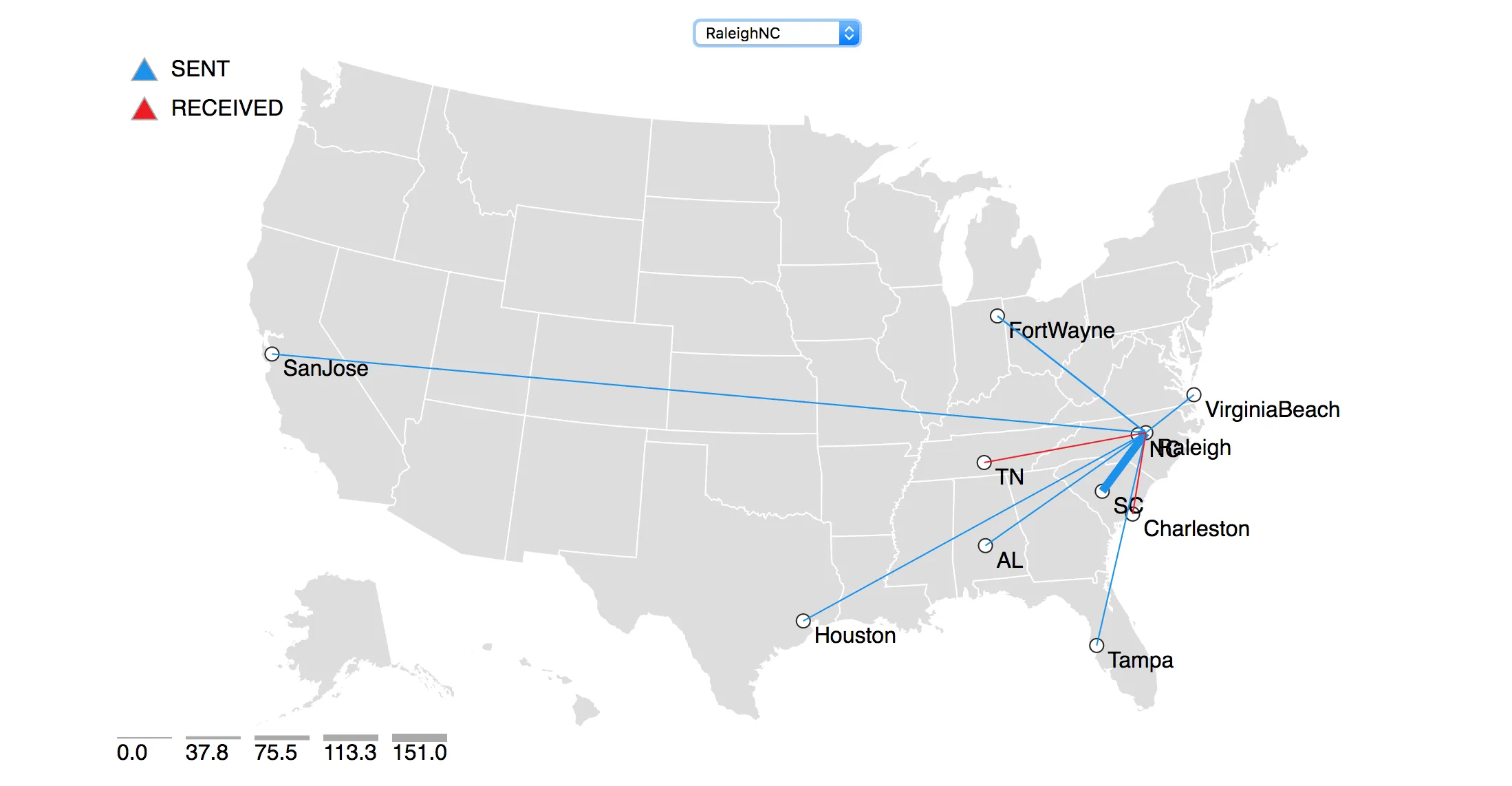
Data exploration of inflows and outflows of city trash to other cities. Data from the US Commodities Survey from 2012. Project from Science Hack Day 2017
Welcome to the Jear Bear Letter’s third letter of the series “Seven Degrees of Strangers”. If you’ve started reading this series, I interview a stranger one degree of separation at a time. This week, I’m presenting a conversation I had with Joe Lazarra. He runs a butcher shop and fish market in Carmel, Indiana. He also happens to be the previous interviewee, Evan, father’s best friend.
Joe has walked an unconventional path. We dive into his past work, his butcher shop, and so much more.
Enter Joe Lazzara
I wasn’t expecting Joe to be a masterful storyteller. If you ever talk to him, he has a very solid sense of self. He started his story by transporting me back over a century ago. His great grandparents grew up in Sicily. Different invaders have conquered Sicily time and time again. So much so that other Italians call them outsiders. Sicilians have a different dialect and different culture. They value family, culture and food. Especially food.
Joe’s grandparents and their brothers sold produce in California and southern Indiana.
Their lives included stories of escapades, murders, and running from the KKK. If I ever get to hang out with Joe, I’d love him to tell me some of them. What’s important to Joe is the Sicilian heritage followed them to America.
Joe’s mother learned recipes passed down from the older generation. Joe’s aunt taught his mother how to cook, handing them generation to generation. Needless to say, the family bonds over food, like Joe helping make the sauce.
Joe is youngest of 6 children. There’s an 18 year generational gap between his oldest brother and himself. Because of that, his father, his eldest brother, and he are born in different generations. His father was born in the 20s, his brother in the 40s, and Joe in the 60s.
Joe’s father didn’t make much money. Yet, he valued education and funded all 6 children through college. He knew that going to college is important. He didn’t have a large house. He made sure none of his children never paid a dime. Joe’s very fortunate and grateful to his father.
College and Early Career
In college, Joe met Charlie Roar, Evan’s dad. They became dependable friends and fraternity brothers. Today, they remain close. Joe is a godfather to Charlie’s daughter. Joe’s a part of Charlie’s family as they moved from Chicago to Minnesota to North Carolina. When Joe’s father passed away, you can bet Charlie was there for him and his family.
Joe studied Quantitative analysis, which during the mid to late 80’s, was the thing to study and get a great job. When Joe graduated, he worked at Indiana Bell on a software project. That project got sold to General Telephone and Electric, GTE. But, Indiana Bell didn’t want to help with maintaining the software.
GTE needed consultants. Joe’s co-workers and Joe saw this as an opportunity to create their own consulting company. They formed United Informations Technology. Joe was 23 at the time and moved with the company to Tampa Bay. On weekends he’d invite friends. The job demanded Joe travel all over. With the sales commissions, Joe was making 6 figures. But the company’s success didn’t last long. The company hired an HR manager to manage pensions as they started growing. But, no one else knew this HR manager would take their pensions and buy coke in Florida and resell it in Chicago. One day, the FBI and DEA knock on Joe’s door asking about the illegal activity. Joe exits as soon as he can; the company gets dissolved.
Joe took a position with GTE in Indianapolis selling cellular to wireless carriers. The market was ripe for cellular networks, and selling was like shooting fish in a barrel. Year over year, Joe was the top 1% of sales people. He rose the ranks and became a general manager over other sales people.
During this period, he got married and had kids. He’s in his early 30’s, and he’s traveling all over the U.S. for his sales job. He got tired of going out to the bars with his guy friends. Instead, he uses this time to explore restaurants. Today, many of these restaurants have Michelin stars or are James Beard candidates. Those are prestigious accolades in the food world.
Joe told me a story of how he met Emeril Lagasse before he was famous. He was in New Orleans. Charlie’s cousin invites Joe to meet Nellie Brennan, owner of Brennan’s restaurant. Nellie brings them to the Commander’s Palace to meet the head chef, who turns out to be none other than Emeril. This was right before he opened his flagship restaurant. Well before he was a Food network celebrity.
Joe meets Susan Spicer before she became big at the Bistro at Maison de Ville. Some of these restaurants catch wind of Joe, thinking he was a food critic. They would invite him at the Chef’s table if he called. When they found out he was only a food enthusiast, they laughed and would cooked up a storm. It was during this time Joe’s food and wine palette expanded.
GTE gets bought out by Bell Atlantic and forms Verizon. Joe becomes in charge of the telecomm act where he has to negotitate contracts on behalf of Verizon. He has to travel even more. In 1999, Joe quits to join a telecomm start-up in Indiana, First Mile Technology. The company was ahead of their competitors.
Business was going well. Then 9/11 happened. VC capital dried up. Joe had a tough time getting developers to invest upfront because they didn’t have the money. Joe left and consulted for a bunch of small companies.
After that, he consulted for a few years. But Joe grew tired on traveling around. Clients were asking Joe to do things that tested against his principles. For example, they asked him to move phone numbers around, move money around, and lose trails. He sought solace from his brothers and Charlie. They reminded him of wanting to start a restaurant or be in food.
Butchershop
Carmel, Indiana is a progressive city and their mayor wanted to build a city center. The mayor asked Joe if he wanted to start a restaurants there. When Joe asked his wife, she objected. She told him they have three children, ages 3, 5, and 7, and he wouldn’t be there for them at night. Joe remembered his friend, Mark Zannoni. He was also Italian, and Mark’s father owned a butcher shop outside of Chicago. Joe asked his wife about a butcher shop, and she agreed that would be a better choice.
They put about a year of work into opening the shop before it opened. The first year’s return was at a loss, but since then, they’ve been on the up. They’re netting a few million a year, and it has become such an integral piece to the community. Joe’s been at it for 11 years. You can find the butcher shop and fish market’s website at the end of the article.
There was an old couple that used to shop at Joe’s butcher shop weekly. They loved talking to Joe and the staff. One week, Joe noticed the husband stopped coming. The next Saturday, she came in early, right after the opening hour. She walks through the entrance, dressed top-to-bottom with a red dress.
Joe asked the lady where her husband. The lady leans over the counter and tells Joe her husband passed away. Joe tells her he’s sorry to hear, but the lady stops him.
“I came here to tell you. We loved interacting with you and the staff. Coming here for the past 5 years made him happy.”
Of course, Joe’s ready to melt after this. It’s situations like this that has taught him he’s the caretaker of community trust. He’s seen customers have babies who have now grown to become pre-teens. He caters to community member’s funerals.
Joe tells me it’s not about the money. It’s all about giving back to the people. It’s the satisfaction knowing you are delivering the turkey to your customer’s home during Thanksgiving. Early on, Joe wanted to franchise the business and build many “Joe’s Butchershops”. Now, Joe wants to make his shop iconic, like Ann Arbor’s Zimmerman’s Deli or San Francisco’s Ghirardelli’s Square. Carmel is an up and coming, affluent city, about an hour or two away from Indianapolis. People from all over the state come to visit the butcher shop.
Joe picked the right location, and he owes his success to his background in sales. Without it, he couldn’t see a different side of business. One where the customer gives you feedback and where you listen. Joe’s mission is to share good karma, because things come back. And he can’t see himself doing anything else.
“I sleep at night. I sleep like a baby, for the most part. Whereas before, I was always concerned about the next sale, or how I was going to get that revenue stream.”
Takeaways
Joe’s takeaway makes a wonderful quote. “Love unconditionally, and you will be returned with unconditional joy.” Very humbling.
If you missed the newsletter last week, I started a new writing series. In this series, I interview one person a week, one degree of separation from the last interviewee. The theme of each talk is about connection and communication. This is the second installment of my series about connections and communication.
In the last newsletter, I talked to Simon Gondeck, a young Web Developer and Entrepreneur. This week, I’m talking to Evan Roer, Simon’s close friend. We talk about how he landed his design job, working for clients, and what Evan’s favorite font is.
Enter Evan Roer
The first thing I wanted to know about Evan was how did he know Simon? As Evan recalls, he’s known Simon and Sevy, Simon’s twin brother, for as long as he can remember. Growing up, their families were part of the same gourmet club. Years ago, Evan’s family moved to North Carolina. Evan was in third grade, yet the families kept in touch. For example, Evan’s older brother is roommates with Simon’s older brother. And, if Evan’s traveling to Minneapolis, which happens once or twice a year, he’s staying with Simon.
Evan resides in Raleigh, North Carolina. He works for Design Dimension, a design firm specializing in exhibit design for museums. He started this job over a year ago and has an unconventional story on how he got there.
Landing the Job
Evan was a brand ambassador at North Carolina State University. That means Evan would prepare the university’s recreation center with school events. The school designates brand ambassadors 13 mandatory office hours to do prep work. But as Evan learned, it doesn’t take that long to set up tables and handout merchandise. With this idle time, he noticed peers making posters in the gym promoting upcoming events.
Evan wasn’t studying graphic design. He was studying business marketing. He wanted to follow a creative itch and make posters. As Evan puts it, he got to see graphic design in the works. He would create posters, learn the tools from Lynda.com tutorials, and develop a portfolio. With his boss’ permission of course. By the end of Evan’s college career, he had an extensive portfolio.
After graduating, Evan was looking for a job. Evan applied to design studios and businesses seeking his skills in Business Marketing. One of those design firms he submitted his portfolio to was Design Dimension.
Evan got an internship with a tech firm. He said the office was decorated like a Silicon Valley start-up. A week or two later, Design Dimension called him. He thought it would be worth a shot at the interview since his current role may not hire him full-time. It was convenient his internship was five buildings away from the Design Dimension.
Evan was the only candidate without a design degree. He meshed well with the firm’s lead designer, Betsy, his future boss. She liked Evan’s portfolio, and even more, his tastes and preferences in beer and music. And it helped they both went to the same school where Evan’s fraternity had close ties to Betsy’s sorority. Betsy likes to blast music in the design studio. Whoever she had to work with would have to be tolerant of that. The candidate had to mesh well with her. And Evan sure did.
Design Dimension
What does it mean to be a professional designer at Design Dimension? From Evan’s perspective, it sounds like a lot of work. He could be juggling many clients at once. “People don’t like to read long paragraphs”, he tells me.
For example, Evan could be working for a Botanical Garden. The job could be to layout a design for explaining photosynthesis. Evan’s work is to take the given space and design the entire experience. Evan knows the exhibitors don’t want to read a barrage of words when they can see pictures.
I thought back to my recent trip to the American Museum of Natural History in New York. The museum had a forest canopy exhibit. There was some text to go with the massive forest installation. But the text was not important to me. I was in awe of the size of the trees with its intricate details. The text is an example of hidden design, open to the curious but not distracting to others.
Restraint
Being a designer means knowing when to restrain. Evan will try to push his client’s brand. For example, a Town Hall, the Opera House in Sumter, NC, or small companies. But if he’s working for an established corporation, like IBM or the Raleigh-Durham International Airport, he will stay within the boundaries of their existing brand.
Restraint also comes to play with dealing with clients. Evan may have clients where his clients want to be the graphic designer as well. The feedback sounds more like barking orders. If he finds himself arguing with a client, and the client is wrong, he has to find a way to come to a compromise. “And that’s what pushes you as a designer”, he tells me.
Clients
In general, the clients come with the content. It’s Design Dimension’s job to make it presentable. And the clients are super involved from start to finish. When Evan was working for a “Black History of Wilson” exhibit in Wilson, North Carolina, the clients wanted to pack as much information as possible. But, it doesn’t tell a story. The client is wrong, and it’s Evan’s job to convince them to change their content by selling them on the design idea.
The work can be rewarding. Evan worked on a children’s museum in Wilson that teaches science and history. Before the design firm came in, the museum was outdated, a relic from the 80s. The museum’s administrator secured the funds to update and upgrade the space. and Evan’s team worked with the administrator to come to a good design. When it was all said and done, this space was resurrected, brought back to life with updated science. And for the administrator, her reaction was priceless because she put her heart and soul in it.
Feedback
It’s only recently Evan’s had interactions with the client. A theme from last week’s newsletter was feedback and criticism. I wanted to know how Evan deals with those themes. Evan tells me it pushes you to be better. You have to be able to speak the same language, and rarely does one design iteration is enough. As a great designer, you have to be able to let things go. Even if Evan thinks one of his logos looks damn amazing, the client could reject it and have the whole process start over. Evan’s learned to let that go.
Takeaways
Evan’s takeaway for you is to make connections in life. Everything’s connected in relationship to each other. And to find those and be able to point those out is a fun thing to do. Put yourself out there. Make connections.
Random Tidbits
After our interview, I hired Evan to create illustrations. Credits to Evan for the letterhead and accompanying illustrations for each letter
Evan loves discovering music, new and old. His favorite music festival is Bonnaroo in Tennessee
Welcome to the next installment of the Jear-Bear Letters. After a half year
hiatus, we’re back with a new series called “Seven Degrees of Strangers”.
The title is a play on “Seven Degrees of Separation” where you are at most
seven links away from knowing any random stranger on Earth. So if I met a
stranger on the street, I could trace them to at most seven degrees of
separation until I found a connection.
Over the course of the next 7 weeks, I will write about the conversation I
had with 7 people, each one degree of separation away. I’ve chosen
communication as the theme for each conversation, trying to understand what it
means to communicate to each other and how can we build connections when we
don’t know the stranger. You’ll get to hear their stories and experiences, and
how I relate to them.
Why are you doing this project?
It started with a thought about connections. On LinkedIn, you can see
potential new friends who are second or third degrees of separation. I
wondered, who are these people? How does everyone know each other? If I
continue down the path of separations, could I meet someone famous?
Then in May, while I was conceiving the idea for this series, I went to a talk
with Bill Burnnett and Dave Evans. They are professors at Stanford who wrote a
book called “Designing Your Life”. In their talk, they asked everyone to turn
to their side, speak with their neighbor, and ask them something you need help
with. I turned to my neighbor, we introduced ourselves, and I asked about a
question about appropriative technologies. She didn’t have any tips, but she
knew someone who could direct me to who might.
I pondered about the interaction for a week. It’s not an everyday feeling for
me to ask for help from strangers. Even though the woman didn’t know someone
directly, she knew of someone who could get me closer to my answer. This
project is my exercise to practice that power of connectedness.
Throughout the series, we’ll find out what connectedness means to other
people. And build a new connection by the end of our conversation.
The First Degree of Separation
To begin this series, I reached out to my friend, Simon Gondeck. He’s an
entrepreneur and web developer for his own consulting company,
MG Web Partners. Besides catching up with an
friend, I wanted to probe him about starting a company. Simon did not disappoint. In our conversation, he went over that and so much more.
Enter Simon
Simon’s a recent grad from the University of St. Thomas with a B.S. in
Accounting. I met Simon three years ago at a software bootcamp. At the time,
he was on his summer break; he was one of the younger members of our cohort. He clicked with me because I grew up in the Bay Area and he wanted to know if I knew G-Eazy. I didn’t, but I know people who knows the rapper, and Simon kept asking more questions about the Bay Area.
And I loved Simon’s enthusiasm. We paired programmed a few times and hung out
outside of the program. I got Simon to join our final team project where we
created a social network for grieving. Simon was a total team player and
whooped my ass into gear when we took a break at the gym.
Simon’s an athlete and spent his college term playing lacrosse player.
Unfortunately, at the time we were talking, he was recovering from an injury
when we had the interview. I realize that he’s a person to go to for my
atheletic questions, so in the future, I’ll be reaching out to him more.
MG Web Partners
After the software bootcamp, Simon returned to school, living in St. Paul,
Minnesota. He got a part-time job working at a web consulting company. While on the job, he discovered he was compensated far less than the contract stipulated.
An epiphany came when he was at a yoga class. The studio were in need of a
website, but all of the contractors they found were out of their budget. Simon and his friend Johnny and he drafted a reasonable offer, and they got their first contract. MG Web Partners was born.
Lessons on Starting a Business
Before their first contract, Simon and Johnny had little to no knowledge on
how to draft one. They looked online to figure out what a contract should say.
And contracts weren’t the only thing they had to figure out for the business.
Simon brought on his twin brother, Sevy, to help out with growing the
business. One of their challenges the team faced was to find more customers.
They drove around the area, going business to business to attract more
customers. They sent out an email campaign last June, seen below.
My partners Johnny Mulvahill, Sevy Gondeck and I have started a web design
and development company called MG Web Partners.
We specialize in building businesses remarkable websites that deliver new
customers and drive revenue.
We help three kinds of companies:
Companies with outdated websites
Companies with poorly designed websites
Or Companies that just need a new website
Most companies fit one of these three scenarios, so if you know of anyone,
please forward them my contact information and I promise we’ll take good
care of them.
Simon was hesitant to use email marketing and social media because he viewed
it as mass spam. He didn’t want disinterested people to see his work, and
worse, find he was bombarding friends and family with unnecessary mail. Sevy
convinced Simon to reach out and not worry about that. What you write will
have no interest to some people, and a lot of interest to a few people. You
never know who those people are until you cast a wide net.
Listening to Simon talk about his business reminded me how much we learn on the job. When we talked about the details of drafting proposals, Simon talked about the mistakes he previously made. For example, it’s better to draw up a proposal that’s less stringent and allows for flexibility with the client. And it’s better to make the process transparent, so the company uses
Proposify, a website that allows clients to review proposals while also giving the business insight into how their clients are reviewing their proposals.
Upon reflection, Simon says the best strategy that attracted the most customers was word of mouth. In the business of contracting, referrals matter more. Having previous clients tell potential future clients of their work has been more substantial than other techniques. And with every new client, the business learns they learned something new.
And while we’re on clients, how do you communicate with them? Simon has found the best way is to make a phone call or face-to-face. Texting and email interactions are easy to evade and do not convey the same tone as his voice.
After the customer signs off on the proposal and agrees to the timeline, the team gets to work on the project. After the first design iteration or prototype, the team shares it with the customer to review. The team has learned that it reduces the amount of time on wasted work if there’s less guesswork on details.
What’s Next?
The team has worked with clients all over the area. All of the team members have graduated college. Sevy will be leaving the company later this summer to join Deloitte. Simon still plans to growing this company, and getting the formula right before bringing more people on.
Questions for me
After our conversation about MG Web Partners, Simon turned the tables and asked me a few questions. The benefit of being a first connection is they already know something about you. And in Simon’s case, he’s a long time reader of the Jear-Bear letters, so he had some questions around writing and growing an online presence.
On Writing
Simon asked some advice about creating a writing habit and how to get through
writer’s block. One of his goals is to boost
his company’s blog by writing more
frequently. I had a few recommendations for him.
Write a minimum amount every day. I choose a page a day.
Read “Bird by Bird” by Anne Lammont, or at least the chapter on “Shitty
First Drafts”.
Don’t be afraid to delete. This one took me a long time. In fact, while writing this section, I deleted half of my work because it didn’t matter.
Don’t expect success. As counter-intuitive as it may be, that piece of advice helped me release what I consider terrible writing to my letter friends. A few of those letters have been very well received, like my “Caltrain Suicides” letter and my “Lost Keys” letter.
Editing is just as important as writing. And its corallary: Polishing takes more time than writing.
Find peers to review your writing. Earlier on in my letter writing, I decided to open up each letter for critique.
I reached out on Twitter to see who could be my critique, and a few people
helped me. I’d send a draft out, and they would give me some helpful criticism.
Take-aways
I asked Simon what’s one thing he wants people to take away with.
Over-communicate with clients. It might not always be clear what they want.
Don’t do it over email. Do it over the phone or in-person, if you can.
Next Week
At the end of each interview, I asked the participant to choose the next person for me to interview. At first, I was loose on criteria, but as I progressed with each interview, I decided to give the participants a question. Who is someone you know you would like to hear an interview from?
I didn’t get to ask Simon this question, yet he knew intuitively I was looking for someone interesting. And he didn’t disappoint. Hope that’s tease enough for you to continue reading.
Acknowledgements
I’d like to thank Simon Gondeck for being the very first participant. Without you, I wouldn’t have started this journey. I’d also like to thank Evan Roer for illustrating the series’ letterhead and an accompanying graphic for this letter. Both of you rock.
Brace expansion is used to generate arbitrary strings. The specified strings are used to generate all possible combinations with the optional surrounding preambles and postscripts.
Usually it’s used to generate mass-arguments for a command, that follow a specific naming-scheme.
:!: It is the very first step in expansion-handling, it’s important to understand that. When you use
echo {a,b}$PATH
then the brace expansion does not expand the variable - this is done in a later step. Brace expansion just makes it being:
echo a$PATH b$PATH
Another common pitfall is to assume that a range like ”{1..200}” can be expressed with variables using ”{$a..$b}”. Due to what I described above, it simply is not possible, because it’s the very first step in doing expansions. A possible way to achieve this, if you really can’t handle this in another way, is using the ”eval” command, which basically evaluates a commandline twice: eval echo {$a..$b} For instance, when embedded inside a for loop : for i in $(eval echo {$a..$b}) This requires that the entire command be properly escaped to avoid unexpected expansions. If the sequence expansion is to be assigned to an array, another method is possible using declaration commands: declare -a 'pics=(img{'"$a..$b"'}.png)'; mv "${pics[@]}" ../imgs This is significantly safer, but one must still be careful to control the values of $a and $b. Both the exact quoting, and explicitly including “-a” are important.
The brace expansion is present in two basic forms, string lists and ranges.
It can be switched on and off under runtime by using the ”set” builtin and the option ”-B” and ”+B” or the long option ”braceexpand”. If brace expansion is enabled, the stringlist in ”SHELLOPTIONS” contains ”braceexpand”.
String lists
{string1,string2,...,stringN}
Without the optional preamble and postscript strings, the result is just a space-separated list of the given strings:
$ echo {I,want,my,money,back}I want my money back
With preamble or postscript strings, the result is a space-separated list of all possible combinations of preamble, specified strings and postscript:
The brace expansion is only performed, if the given string list is really a list of strings, i.e. if there’s minimum one ””,”” (comma)! Something like ”{money}” doesn’t expand to something special, it’s really only the text ””{money}””.
Ranges
{<START>..<END>}
Brace expansion using ranges is written giving the startpoint and the endpoint of the range. This is a “sequence expression”. The sequences can be of two types
integers (optionally zero padded, optionally with a given increment)
characters
$ echo {5..12}5 6 7 8 9 10 11 12$ echo {c..k}c d e f g h i j k
When you mix these both types, brace expansion is not performed:
$ echo {5..k}{5..k}
When you zeropad one of the numbers (or both) in a range, then the generated range is zeropadded, too:
$ echo {01..10}01 02 03 04 05 06 07 08 09 10
There’s a chapter of Bash 4 brace expansion changes at [[#new_in_bash_4.0 | the end of this article]].
Similar to the expansion using stringlists, you can add preamble and postscript strings:
When you combine more brace expansions, you effectively use a brace expansion as preamble or postscribt for another one. Let’s generate all possible combinations of uppercase letters and digits:
Brace expansions can be nested, but too much of it usually makes you losing overview a bit ;-)
Here’s a sample to generate the alphabet, first the uppercase letters, then the lowercase ones:
{% assign special = '{{A..Z},{a..z}}' %}$ echo {{ special }}A B C D E F G H I J K L M N O P Q R S T U V W X Y Z a b c d e f g h i j k l m n o p q r s t u v w x y z
Common use and examples
Massdownload from the Web
In this example, ”wget” is used to download documentation that is split over several numbered webpages.
”wget” won’t see your braces. It will see 6 different URLs to download.
See the [[#news_in_bash_4.0 | text below]] for a new Bash 4 method.
Repeating arguments or words
somecommand -v -v -v -v -v
Can be written as
somecommand -v{,,,,}
…which is a kind of a hack, but hey, it works.
More fun
The most optimal possible brace expansion to expand n arguments of course consists of n’s prime factors. We can use the “factor” program bundled with GNU coreutils to emit a brace expansion that will expand any number of arguments.
function braceify { [[ $1 == +([[:digit:]]) ]] || return typeset -a a read -ra a < <(factor "$1") eval "echo $(printf '{$(printf ,%%.s {1..%s})}' "${a[@]:1}")"}printf 'eval printf "$arg"%s' "$(braceify 1000000)"
“Braceify” generates the expansion code itself. In this example we inject that output into a template which displays the most terse brace expansion code that would expand ”“$arg”” 1,000,000 times if evaluated. In this case, the output is: